

China
Exclusive: Internal Records Reveal Pyongyang’s Wage Theft from Workers in China
Radio Free Asia revealed that the North Korean government seizes about 90% of wages of laborers sent to China. Internal documents show workers only receive 100-300 yuan monthly while companies pay 2,500-4,000, leading to severe exploitation and discrepancies in reported wages.
Read a version of this story in Korean
[Editor’s Note] Radio Free Asia recently obtained internal documents, on-site videos, and photos from a North Korean overseas dispatch company that has sent laborers to China. Most of these materials were produced in the first half of 2025 and include contracts between North Korean and Chinese companies as well as details on the “application of employee living expenses,” which is how their wages are classified. RFA has also secured a significant number of videos and photos of North Korean workers employed at Chinese companies. RFA’s analysis of these materials presents a harsh reality for these workers that includes stolen pay and poor working conditions. To protect sources, some parts of the documents will be redacted, and only selected scenes from the videos will be released as still images.
The North Korean government confiscates around 90% of the wages earned by workers it dispatches to China, internal documents obtained by Radio Free Asia revealed.
Sources in China have previously told RFA that the North Korean companies that handle the dispatched workers in China collect their wages and forward most of the money to Pyongyang in the form of “loyalty funds,” extra support for state projects, and other fees.
According to the sources, a Chinese company will typically pay around 2,500 to 4,000 yuan (about US$375 to $600) per month for every North Korean dispatched worker, but the worker will actually only receive 100 to 300 yuan ($15 to $45).
But the documents – which were made in early 2025 – include contracts, ledgers and other accounting records and are the first known instance where the deductions for the state are confirmed in print.
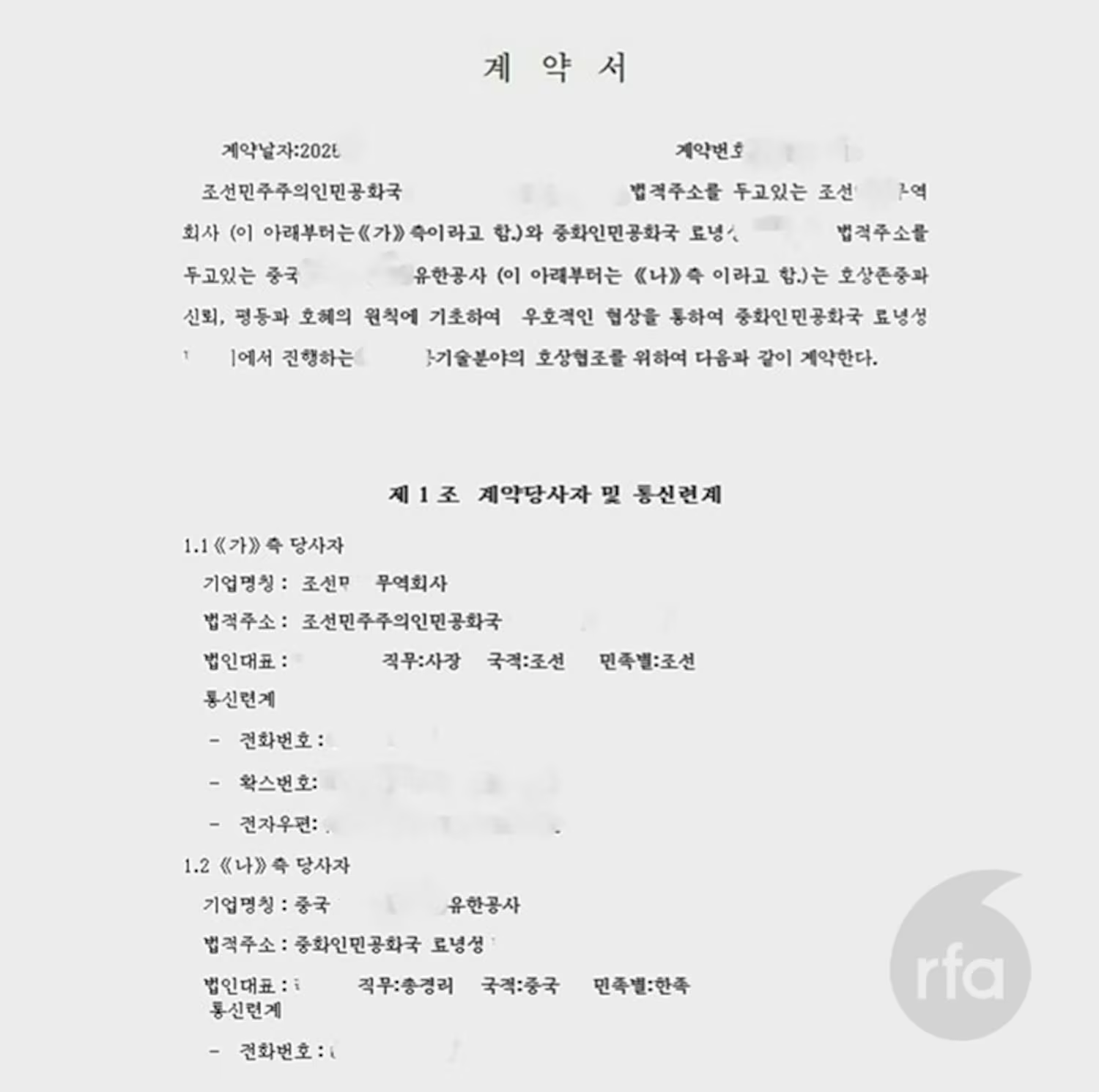
One contract, between a clothing company in China’s Liaoning province and a North Korean worker dispatch agency shows the details regarding the workers’ wages:
According to Article 4, Clause 1 of the contract, the Chinese company will pay the dispatch company a monthly rate of 5,000 yuan for managers; 4,000 yuan for “assistants” – actually a worker surveillance agent dispatched by Pyongyang’s State Security Ministry; and 4,000 yuan for interpreters. The Chinese company will pay 3,500 yuan for “skilled workers” – the majority of the dispatched personnel, and this includes meal expenses. Clause 2 states that during a two-month training period, the Chinese company will pay 1,500 yuan per North Korean worker.
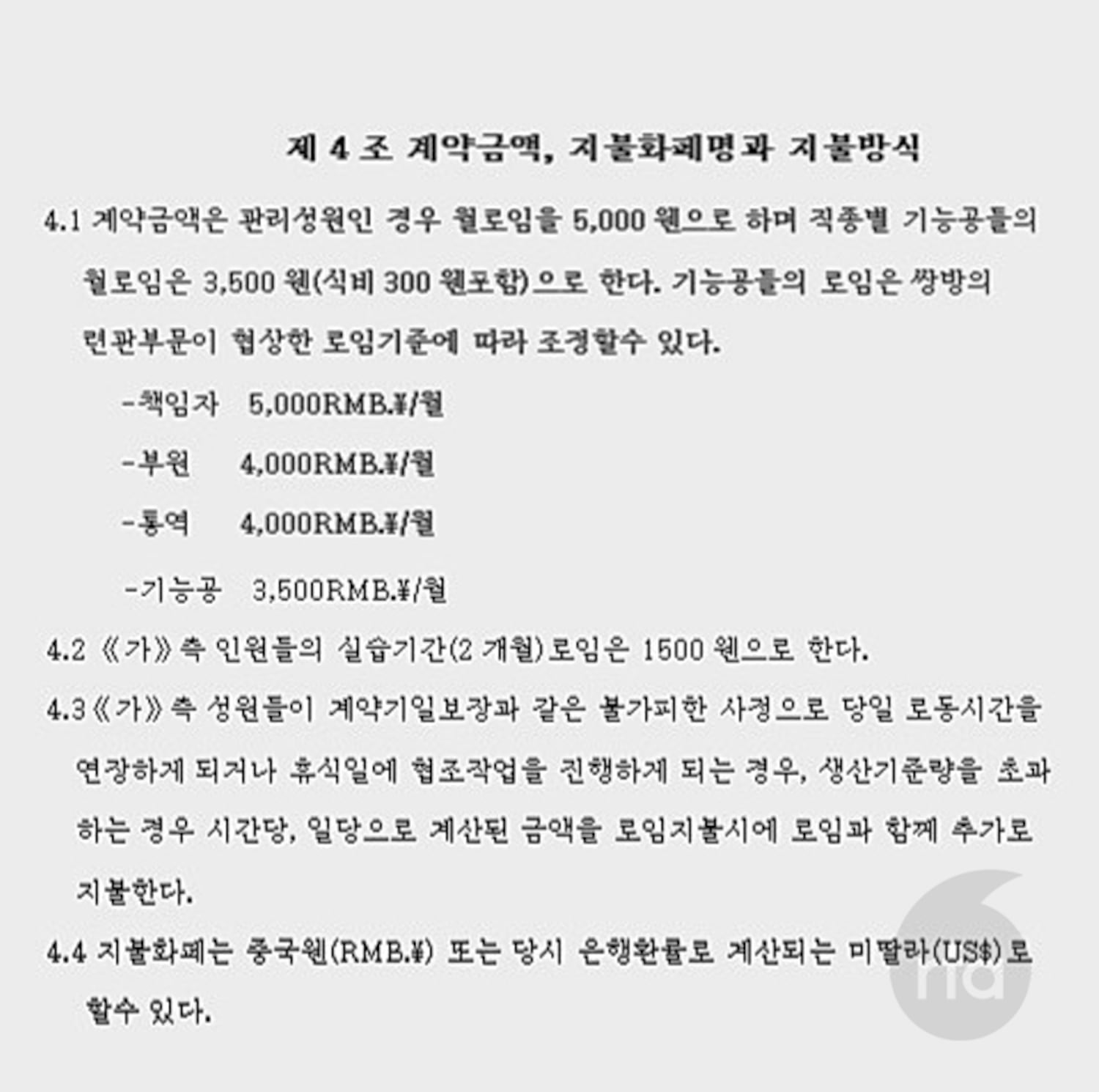
On paper, it appears that each North Korean worker could expect to be paid a wage of 3,500 yuan (about $525) per month. This would be a hefty sum, enough to buy close to a metric ton (2,200 pounds) of rice in a North Korean marketplace, at a time when most domestic North Korean workers can’t even afford a single kilogram with their monthly salaries.
But an examination of other documents shows a discrepancy between what the contract stipulates and what the manager of the dispatched workers recorded. The dispatched companies classify the workers’ wages as “living expenses.” A “Living Expense Analysis Table,” that the manager sent to the North Korean headquarters shows that the company received only 2,600 yuan per worker per month. The discrepancy is not accounted for in the documents.
It is highly likely that the manager in this case was setting aside slush funds with the approval of the headquarters’ president, Ri Jong Ho, a former high-ranking official at an organization under Office 39, the clandestine group formed in the 1970s to manage slush funds for the North Korean leadership, told RFA.
“The president of the headquarters in Pyongyang must provide imported goods and foreign currency demanded daily by officials of powerful institutions,” he said. “It is highly probable that he asks the dispatched manager for help each time.”
Ri explained that the manager has to come up with the money somehow and the only way to do this is to dip into the wages.
“Discrepancies between the contracted amount and the reported amount are a phenomenon that…
Read the rest of this article here >>> Exclusive: Internal ledgers show how Pyongyang steals wages from its workers in China


