

China
Kim Jong Un’s China Visit Challenges Pyongyang’s Korean War Myths
North Korean leader Kim Jong Un’s recent visit to China signifies deepening ties between North Korea and China while acknowledging historical connections previously downplayed. The trip coincided with the anniversary of Chinese troops’ entry in the Korean War, highlighting their joint history.
Read a version of this story in Korean
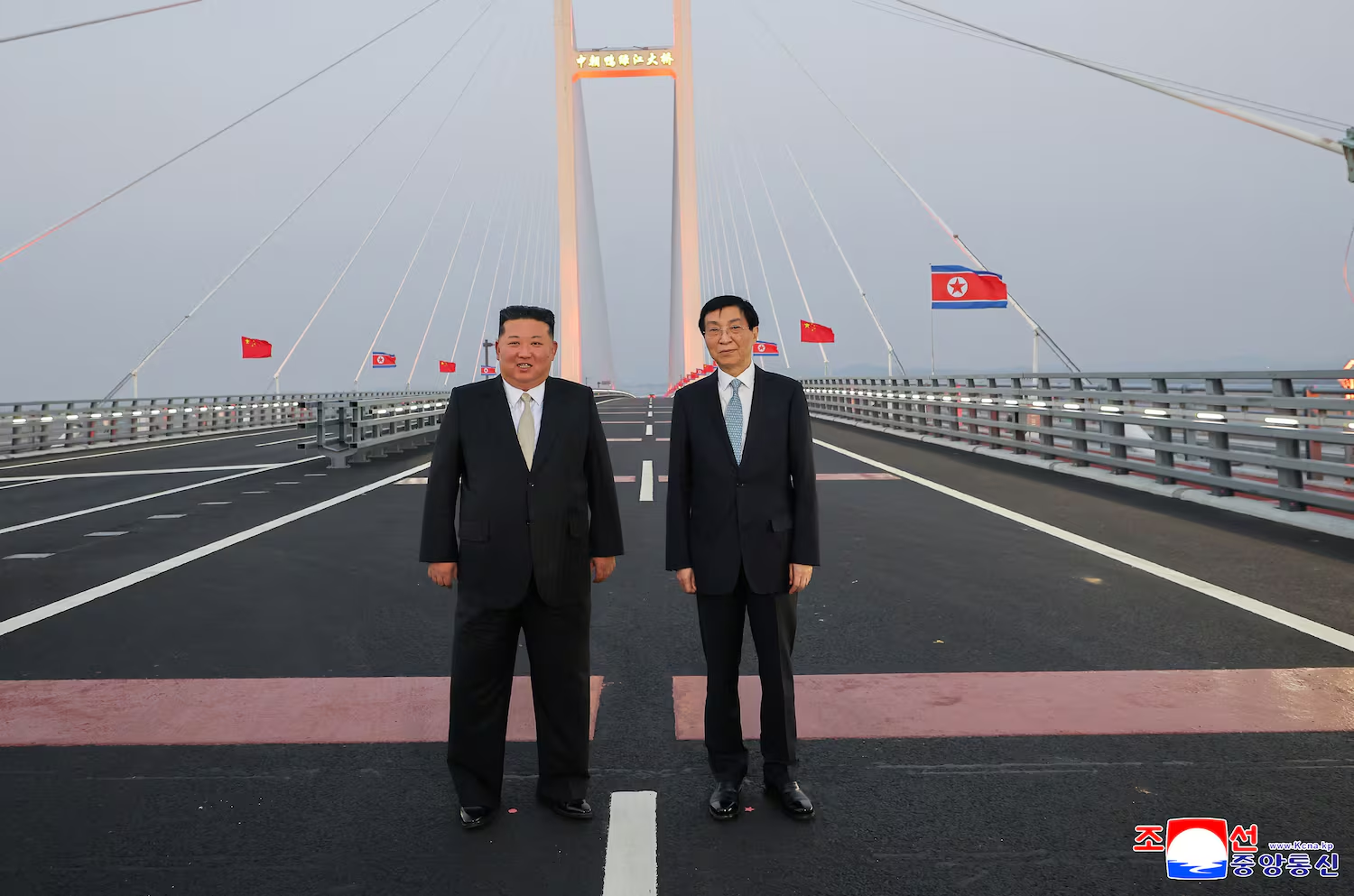
North Korean leader Kim Jong Un’s weekend visit to China over the newly completed New Yalu River Bridge was largely symbolic, and acknowledged a history that Pyongyang has downplayed for three generations, experts told Radio Free Asia.
During Saturday’s unprecedented one-day car trip to Dandong, China, across the border from North Korea’s northwestern city of Sinuiju, Kim inspected a bus factory, met with high-ranking Chinese officials, and visited a monument that commemorated China’s entry into the Korean War.
The timing was significant. The visit was on the eve of the 76th anniversary of the Chinese People’s Volunteer Army’s Oct. 25, 1950 first combat against South Korean and U.N. forces in the war, which would rage on for another three years as the Chinese-backed North and U.S. and U.N. backed South fought to what is largely considered to be a stalemate.
The state-run Korean Central News Agency noted that after Kim and the North Korean delegation toured the Memorial Hall of the War to Resist US Aggression and Aid Korea, and paid their respects, he told the Chinese People’s Political Consultative Conference Chairman Wang Huning – the fourth highest ranked official in the Chinese Communist Party – that it was North Korea’s duty to remember the sacrifice of the Chinese army.
“It was a moment to recollect the preciousness of the DPRK-China friendship forged at the cost of blood,” the report attributed him as saying. “We will always remember the history when the excellent sons and daughters of the Chinese people helped our revolution at the cost of their blood and steadily and firmly carry forward the history of the DPRK-China friendship,” Kim said, in the report.
Though international media outlets characterized Kim’s day trip to be an effort to expand trade ties between Pyongyang and Beijing, the visit to the memorial hall was the most important part of the itinerary, Ri Jong Ho, who was once a high-ranking North Korean official but escaped to the South and currently lives in the U.S., told RFA.
“A bridge that stayed closed for twelve years opened only days before Kim crossed it, and on the same day the supreme leader stood before a history his regime has avoided for more than seventy years,” said Ri, questioning whether that was a coincidence or pressure from Beijing, which financed the majority of the new bridge, which lay in a state of near-completion since 2014 before finally opening for trade traffic on Oct. 15.

There is a consensus among historians that North Korea’s survival in the Korean War was due to Beijing deploying troops to aid Pyongyang, but the story is different inside North Korea.
According to that version of history, the North Korean military under the tactical genius of Kim Jong Un’s grandfather, national founder Kim Il Sung – with only minimal support from China – was able to stave off defeat against an overwhelming force led by the U.S.
This narrative was important from Pyongyang to maintain because it aligns with the country’s founding Juche ideology of self-reliance.
“Pyongyang will present the photographs as proof of an unbreakable friendship. But those inside the Kim system will see something else: the third Kim leader, bowing in public before a history his grandfather and father suppressed,” said Ri.
“Like-minded totalitarians”
Kim’s visit to Dandong is significant because of the timing, but it is more about managing China’s concerns that North Korea is getting too close to Russia, Sydney Seiler, a senior advisor for the Korea Chair at the Washington-based Center for Strategic & International Studies, told RFA.
“Kim is acting with limited confidence, embracing like-minded totalitarian, autocratic … partners such as Russia and China while ignoring the United States, at least for now,” said Seiler. “Kim is working in a ‘safe zone’ between Moscow and Beijing, ensuring that neither side is overly concerned with Pyongyang’s relations with the…
Read the rest of this article here >>> Kim Jong Un’s unprecedented day-trip to China shatters Pyongyang’s Korean War myths


