

China
Report: China’s Maritime Outposts May Divert Taiwan Allies’ Attention in Event of Invasion
中国在南海的前哨基地可能成为“牺牲品”,但能在北京迅速攻占台湾期间拖慢外军行动。台湾政府报告指出,这些基地可在关键48至72小时内分散注意力,帮助实施两栖登陆和封锁。
Chinese outposts in the South China Sea could be sacrificial lambs—ultimately lost, but formidable enough to bog down foreign forces as Beijing executes a swift military takeover of Taiwan, a Taiwanese government report reviewed by Radio Free Asia revealed.
Beijing’s maritime outposts could provide enough distraction during a critical 48 to 72 hour window—just enough time for Beijing to conduct amphibious landings and set up a blockade, said the report, commissioned by Taipei’s Mainland Affairs Council, the government body responsible for China policy and cross-strait relations, and conducted by the Institute for National Defense and Security Research.
Experts told RFA that although the Chinese buildup in the South China Sea is likely connected to Taiwan, a democratic island which Beijing considers to be its territory, the scenario discussed in the report lacks adequate substantiation through high-level simulation.
“The report’s headline figure of a 48-to-72-hour delay is its own estimate, not something validated by any rigorous test like an open wargame,” Ray Powell, executive director of Stanford University’s SeaLight maritime transparency project, told RFA.
Powell said the logic in the report does however “make sense.”
“Distributed, expendable outposts do complicate an adversary’s planning,” he said. “But a complication is not necessarily a roadblock, and the routes that matter most for Taiwan run through the Bashi Channel and the Philippine Sea, not the South China Sea.”
Land reclamation
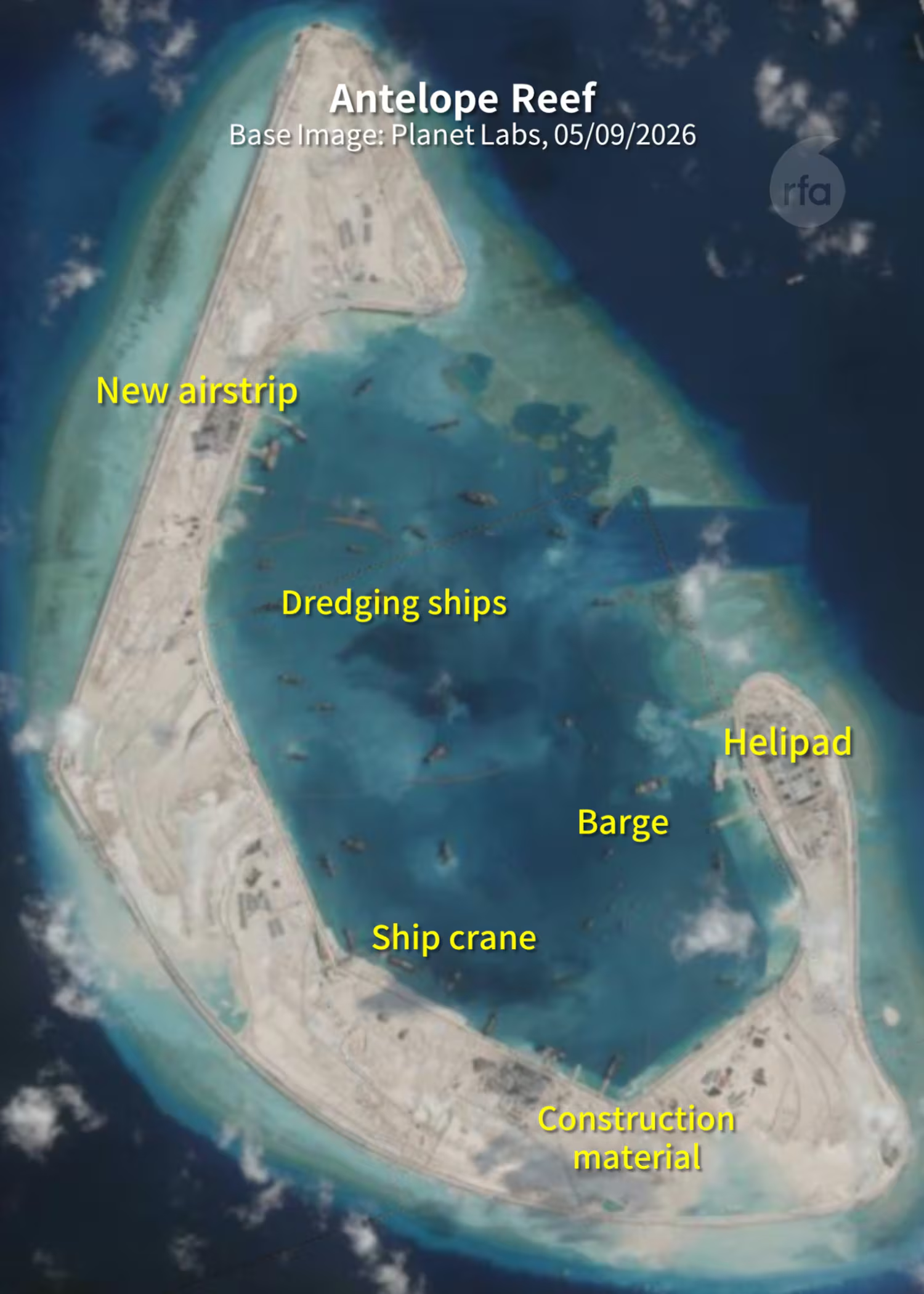
The report was heavily focused on Antelope Reef in the Paracel Islands, where China has reclaimed about 600 hectares (1,480 acres) of land.
The development forms part of Beijing’s broader “active defense” strategy, integrating reclaimed islands into a regional defense network designed to fragment potential U.S. intervention routes and transform the South China Sea into a protected operating zone for Chinese submarines, the report said.
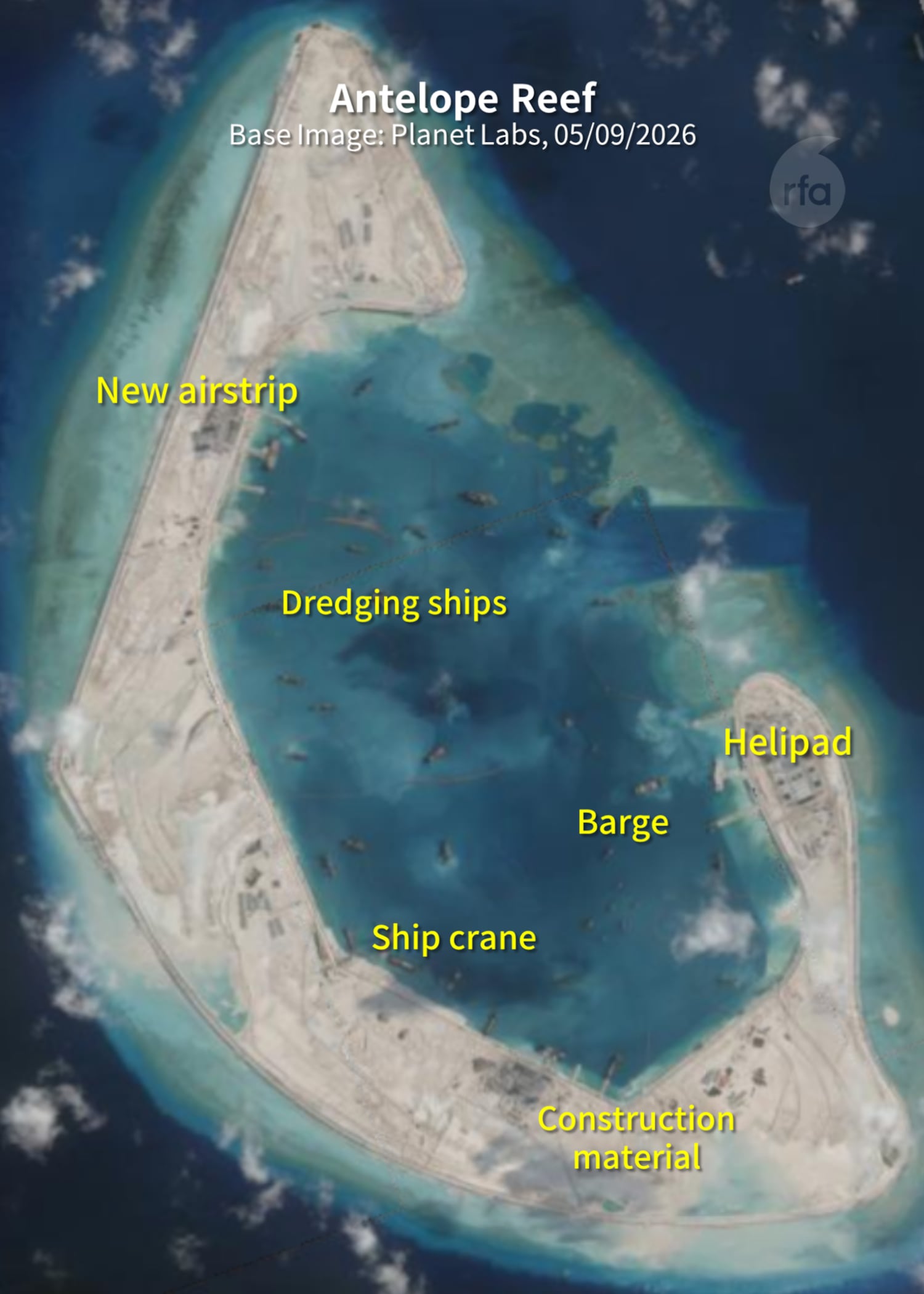
Under that framework, facilities such as Antelope Reef could serve as forward operating bases for China’s coast guard, maritime militia and military forces. The report says they could eventually host surveillance systems, electronic warfare capabilities and anti-ship missiles capable of extending China’s anti-access and area-denial network deeper into the South China Sea.
U.S. carrier strike groups and other naval forces approaching Taiwan through the South China Sea could be forced either to contend with missile, air defense and electronic warfare threats from these Chinese outposts or reroute through alternative approaches such as the Bashi Channel or Miyako Strait, increasing operational costs and travel times, the report said.
Powell also noted that many of the military capabilities described in the report have yet to materialise at Antelope Reef itself.
“What’s actually at Antelope today is reclaimed land, berths and channels—not yet the sensor-and-missile node the report describes,” he said. “That’s a forecast based on China’s Spratly playbook and it may prove right, but the report is analyzing a capability still under construction.”
He added that Antelope Reef’s location in the western Paracels raises questions about its relative importance in a Taiwan contingency.
“Antelope sits in the western Paracels facing Vietnam. Its value to a Taiwan fight relative to China’s many other operational locations across the mainland and the South China Sea is not immediately apparent.”
Broader strategy
Other analysts said that focusing solely on military capabilities risks overlooking the broader strategic effects of China’s activities in the region.
Sze-Fung Lee, an independent researcher specializing in Chinese hybrid warfare, told RFA the debate should not be framed as a choice between military utility and signaling value.
Lee said that the cognitive effects of China’s growing presence in disputed waters could shape decision-making well before any conflict begins.
“Narratives about China’s ability to delay or deny intervention don’t begin when the first shot is fired,” Lee said. “They’re being built now, increasingly visible in the…
Read the rest of this article here >>> Report: China’s maritime outposts could distract Taiwan’s allies if Beijing invades


